


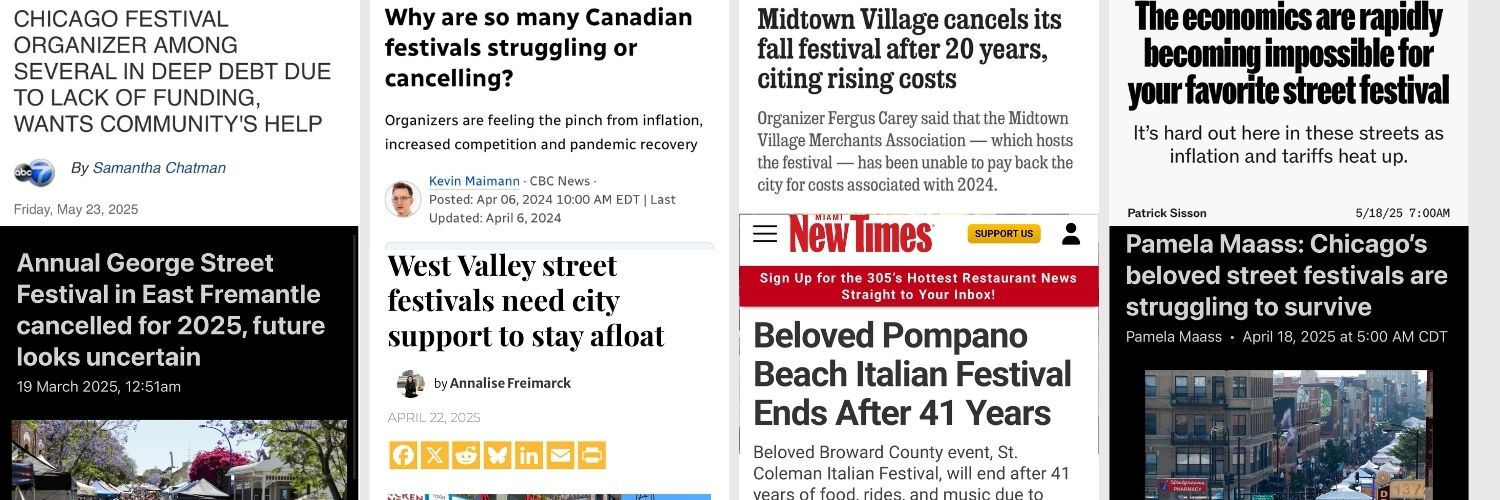
Street festivals across the world Chicago, San Jose, London Montreal, Toronto, Philadelphia, and Perth Australia are canceling, shrinking, or quietly disappearing. To the local public, these decisions might look isolated. To those paying attention the pattern is unmistakable and trending in the wrong direction.
The traditional street festival model that supported neighborhoods for 20 to 30 years no longer fits the economic reality of 2025. Costs have jumped, revenue has stalled and city service requirements have intensified in an ever changing world. This is the year the street festivals broke. But it’s also the year we can rebuild the model in a smarter, more sustainable way.
The Cost Breakdown No One Can Avoid
Production costs have jumped across every category: staging, barricades, tents, power, trucking, and labor. What used to cost $150,000 now pushes $300,000 or more, and the increases happened fast.
Cities are feeling the pressure too, police overtime, sanitation, EMS, fire, and street-closure fees have climbed sharply. A single night market in Philadelphia was billed more than $24,000 in required city services, double the previous year.
The reality is simple you are not running an event anymore you are building temporary infrastructure and infrastructure pricing has rewritten the rules.
Revenue Isn’t Matching the New Reality
Crowds remain strong, people want to gather. But revenue growth has stalled while expenses keep accelerating.
Sponsorship hasn’t grown at the pace of costs
Vendor fees can’t keep rising
Ticketing historically free events creates access barriers
Why This Matters for Cities
Street festivals are not just entertainment, they are economic drivers. They increase foot traffic, boost sales at restaurants and retailers, support small businesses, and bring energy into downtowns trying to regain momentum. When a festival disappears, neighborhoods lose one of their most effective tools for economic vitality.
Where We Go From Here
The next iteration of street festivals won’t be about nostalgia. It will be about sustainability, smarter design, and better use of the assets that neighborhoods already have. Here’s the direction forward.
1. Smaller Footprints With Higher Density
A tight, concentrated footprint can create stronger energy while dramatically reducing costs tied to safety, power distribution, barricades, and staffing.
2. Integrate Indoor Spaces Instead of Rebuilding Everything Outside
Existing businesses and buildings already have power, restrooms, furniture, weather protection, and staff. Using them reduces your temporary build, lowers risk, and pushes festival dollars directly into local businesses. Use curated programming.
3. Layer Programming and Layer Revenue
A festival inclusive of all free programming is no longer sustainable. Festivals need a structure that serves everyone while stabilizing the bottom line.
At B-Side, I use a simple model:
Everyone: Free, open programming
The Many: Low-cost, high-value activities
The Few: Premium, elevated experiences

4. Build More Events, Not Bigger Ones
Instead of one massive blowout, cities can run a series of smaller, repeatable events throughout the year. A steady programming calendar builds community expectation and business predictability.
5. Measure the Impact, Not Just the Attendance
Foot traffic and good vibes are not enough. Cities and partners need clear measurement. Data makes funding conversations easier, it also helps festivals evolve.
Business revenue lift
Restaurant covers compared to baseline
Peak foot-traffic zones
Out-of-district visitors
Economic effects
The Future Street Festival Model
The mission stays the same bring people together, support small business, and strengthen neighborhood identity. The structure just needs to evolve to survive.
Use This Checklist
Focus the festival footprint to reduce infrastructure costs
Use indoor venues to avoid rebuilding what already exists
Structure programming in accessible layers
Build recurring micro-events across the year
Share real costs with city partners
Track economic impact with clear metrics